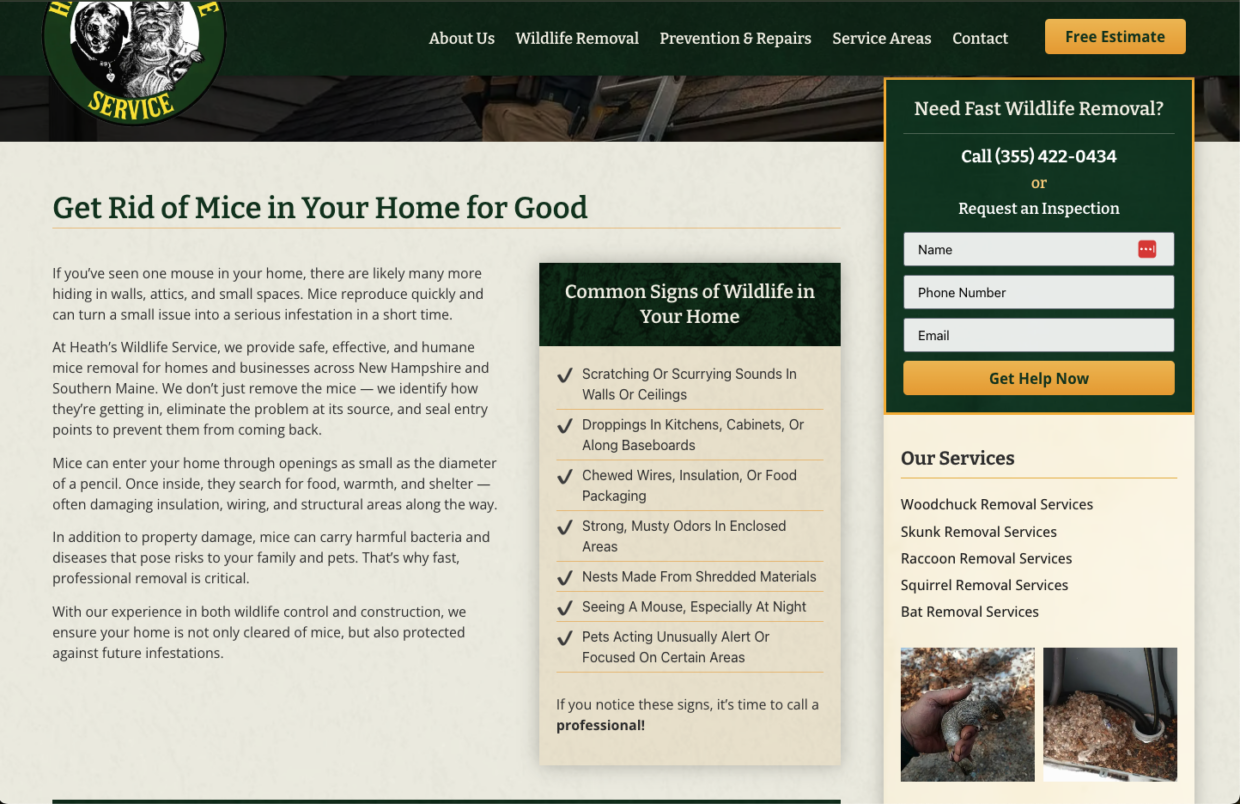
Heath’s Wildlife Service Website Redesign

An SEO-Driven Website Built for Local Visibility and Long-Term Growth

The Heath’s Wildlife Service website redesign was built with a clear goal: create a high-performing, search-focused website that generates consistent leads from local wildlife removal searches. This project went far beyond a visual upgrade, focusing heavily on content structure, service targeting, and long-term scalability through strategic SEO services.

Project Goals

The original website lacked depth and structure, limiting its ability to rank for competitive wildlife removal searches across multiple towns and service types. The goal was to transform the site into a scalable platform that could target specific animals, services, and service areas while improving usability and performance.

  • Build a strong SEO foundation for local wildlife removal searches
  • Create structured service pages for different animals and situations
  • Improve navigation and user experience
  • Develop location-based content for expanded reach
  • Support long-term content growth and rankings

Website Redesign & User Experience

The redesign introduced a cleaner, more modern layout that makes it easier for users to quickly identify their problem and find the right solution. Wildlife issues are often urgent, so the site was designed to guide visitors directly to the services they need with minimal friction. This type of strategic approach is central to effective website redesign for service-based businesses.

  • Clean, professional design aligned with the brand
  • Improved navigation for faster access to services
  • Clear calls-to-action to drive phone calls and inquiries
  • Mobile-first design for users searching on the go

SEO Strategy & Content Architecture

This project focused heavily on building a structured content system that allows the site to rank for a wide range of search queries. Instead of relying on a few general pages, the website was expanded into a network of service pages, wildlife-specific content, and location-based pages designed to capture highly targeted search traffic.

  • Dedicated pages for specific animals (squirrels, raccoons, skunks, and more)
  • Service-specific pages for removal, prevention, and repairs
  • Location-based pages targeting towns throughout the service area
  • Strong internal linking between related services and locations
  • Optimized headings, content, and keyword targeting

Scalable Structure for Service Area SEO

A key part of this build was creating a framework that allows the business to expand its reach over time. By combining service pages with location-based targeting, the site is positioned to rank in multiple towns without becoming disorganized or difficult to manage. This is a core component of how we approach website design for service-area businesses that rely on local search visibility.

  • Structured layout for adding new towns and service areas
  • Consistent page templates for scalability
  • Clear relationships between services, animals, and locations
  • Long-term SEO growth without sacrificing usability

Performance & Technical Improvements

In addition to content and design improvements, the site was optimized for speed and performance to support both user experience and search rankings.

  • Faster load times across devices
  • Optimized images and page assets
  • Clean, efficient code structure
  • Improved overall site stability

The Result

The new Heath’s Wildlife Service website is built to compete in local search and generate consistent leads. With a strong SEO foundation, structured content strategy, and scalable architecture, the site is no longer just an online presence—it is an active marketing tool designed to grow alongside the business and dominate local wildlife removal searches.

provided services

No services provided.

related projects

428 Lafayette Rd.
Unit 5
Hampton, NH 03842